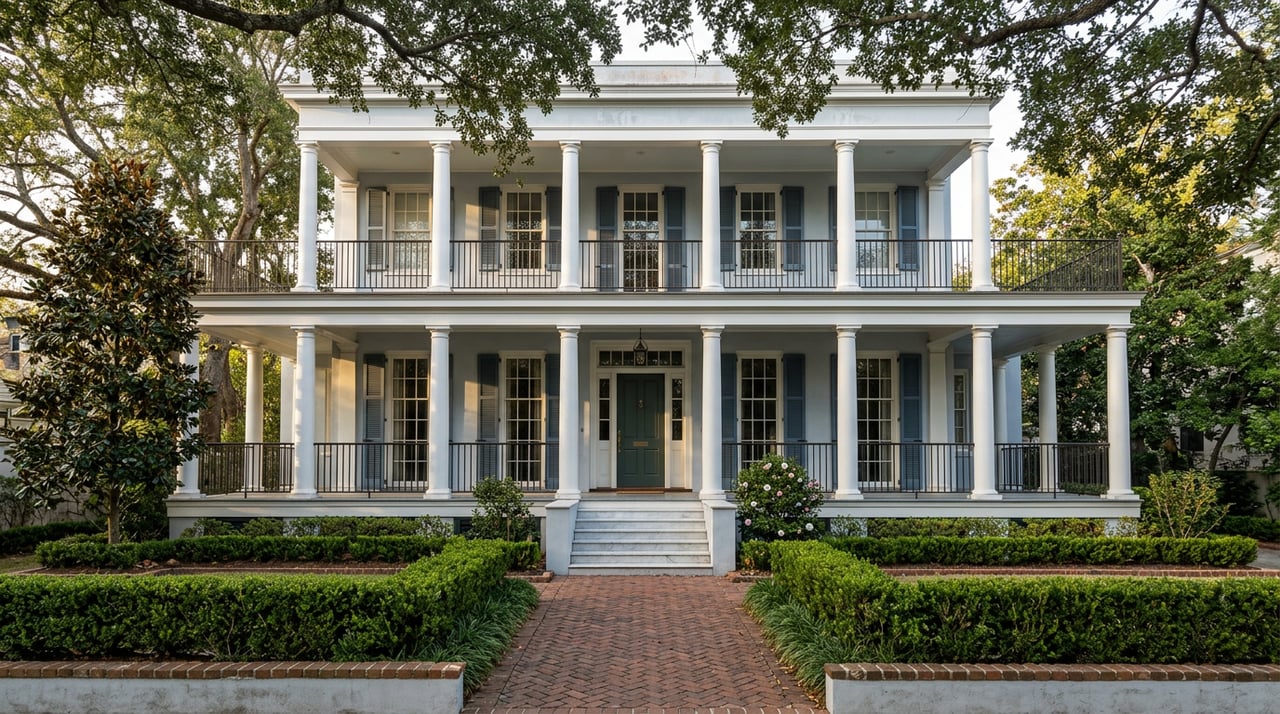
South Of Broad's Days-On-Market Number Doesn't Mean What You Think
Pull two market snapshots for South of Broad homes taken a year apart and you'll get two different stories from the same neighborhood. In October 2024, homes here were averaging 68 days on market. By October 2025, that figure had climbed to 160 days, more than double, with no corresponding headline about the neighborhood falling out of favor.
Neither number is wrong. That's the problem. Treat either one as a verdict on demand and you'll misread the market. Understand why the swing happens, and you'll see the real story underneath it: a small, fiercely specific pool of buyers, a renovation approval process that runs on its own calendar, and a top tier of the market that is, if anything, accelerating.
South of Broad isn't a big enough sample to behave like a normal housing market. When a national or even a citywide market reports days on market, it's averaging thousands of transactions, so one outlier barely moves the needle. South of Broad is counted in a handful of closings some months, and a market that thin doesn't average out anything, it just reports whatever happened to close.
That means a single 1780s double house with a complicated title history, or a waterfront estate priced for a buyer who may not exist yet, can sit for the better part of a year and single-handedly drag the neighborhood average from "fast" to "slow" in the space of one reporting period. Charleston County agents were describing the broader market as still selling within a healthy 30 to 90 day range as of late May 2026, a band tight enough to actually mean something. South of Broad's number, by contrast, tells you more about which specific houses happened to close last month than about the health of the market.
| Snapshot | Period | Reported days on market |
|---|---|---|
| South of Broad, year-over-year comparison | October 2024 | 68 days |
| South of Broad, same tracker one year later | October 2025 | 160 days |
| Charleston County overall, per local agents | Late May 2026 | 30 to 90 days |
Read those first two rows side by side and the neighborhood looks like it fell apart in twelve months. It didn't. The lesson isn't that the data is bad. It's that a single month's average in a market this small isn't a trend, it's a coin flip weighted by whichever houses happened to be on the market that month.
If the headline number is noise, the real friction is structural, and it has a name: the Board of Architectural Review. The BAR reviews new construction, alterations, and renovations visible from the public right of way within Charleston's historic districts, along with any demolition of a building 50 years or older south of Mount Pleasant Street. That covers nearly every exterior change a South of Broad buyer might want to make before or after closing.
The process runs on its own clock, not the closing calendar:
That last point matters more than it looks. A buyer who plans to gut a kitchen can usually move on their own timeline. A buyer who wants to add a screened porch, shift a window, or replace a roof in a different material is now operating on the city's calendar, not theirs. Addition costs across the Lowcountry run $150 to $300 per square foot as of 2026, and a basic screened porch typically lands between $25,000 and $35,000 before BAR-driven material requirements or coastal construction premiums, which run 15 to 30 percent above inland pricing, get layered on.
None of this shows up in a days-on-market chart. It shows up in how long a listing stays contingent, how many buyers walk away from a home that needs exterior work they didn't budget the calendar for, and why sellers with move-in-ready mechanicals close faster than sellers whose homes need visible work.
South of Broad homes typically sell somewhere between 90 and 96 percent of original list price, a gap that's wider than what the broader Charleston market has seen during hotter stretches, when homes have sold at or above asking. Read that gap as weak demand and you'd be wrong. Read it as a negotiation over condition, and it lines up with everything else in this market.
Buyers here aren't haggling over the neighborhood. They're haggling over the house. Downtown agents have described today's buyer as wanting "new wiring, new plumbing, new HVAC and structural updates" before they'll pay full price, which explains why a home with original systems intact sells for less than an identical one that's been quietly modernized behind its historic façade. Add in that BAR-approved windows can run two to three times the cost of a standard replacement, and it's easy to see why a buyer negotiates hard on a house that still has its original single-pane sashes, even if the bones are exactly what they came for.
The takeaway for a seller isn't that the market undervalues historic homes. It's that the market prices the gap between "beautiful and original" and "beautiful and already updated," and that gap shows up in the final number more than it shows up in the days-on-market column.
Any conversation about the Battery corridor now happens against a fresh backdrop. The city finished its Low Battery Seawall Repair Project in February 2026, marking the completion of a construction effort that began in 2019 along Murray Boulevard, the western edge of South of Broad. The finished work raised the wall by 1.8 feet to match the height of the High Battery, rebuilt the structure using glass fiber reinforced polymer rebar designed not to corrode the way the original steel did, and added a 12-foot raised promenade, new storm drainage, and 47 new palm trees along the route.
City officials framed the $71 million project as protection for the historic homes along the corridor against tidal flooding and storm surge, built to the city's planning standard of 2.5 feet of anticipated sea level rise over the next 50 years. That's a factual description of what the city designed and completed, not a claim about any individual property's flood risk, which depends on its specific elevation, drainage, and insurance history. What it does mean for anyone evaluating a Murray Boulevard-adjacent home right now is that the infrastructure conversation has changed since last year. A project residents watched under construction for the better part of a decade is now finished, inspected, and open.
While the neighborhood's overall days-on-market figure whipsaws, the top of the downtown Charleston market has been moving in the opposite direction. Downtown closings above $2 million reached 53 in the first quarter of 2026, up from 32 in the same quarter a year earlier. Per-square-foot pricing at the top end climbed to $1,600 to $1,900 in that same window, up roughly $100 from the prior year. The pink mansion at 5 East Battery, right at the edge of South of Broad, sold for $18.25 million in early 2025, and a downtown sale in October 2025 closed at $21 million, the highest recorded in the region to date.
None of that reads like a market where demand is cooling. It reads like a market where the right house, priced and presented correctly, still moves quickly and for a record number, while the average gets pulled down by houses waiting on renovation timelines, buyer financing for larger projects, or simply a smaller pool of people who can write that check at all.
Don't treat a single month's days-on-market figure as a verdict on your timing. In a market this size, it's closer to a coin flip than a trend line. If you're selling, ask yourself honestly whether your home is competing on condition, not just address, since that's where the 90 to 96 percent gap tends to close or widen. If you're buying and planning any exterior work, find out what BAR review your project will need before you build your timeline around it, because a screened porch that looks like a weekend project on paper can spend months waiting for a second hearing. And if the Battery corridor is part of your search, know that the seawall project residents have watched for years is now finished, which changes what there is to talk about along that stretch for the first time in a while.
Does a slow days-on-market number mean South of Broad prices are falling? Not necessarily. The sample size is small enough that one or two long-sitting listings can swing the average by weeks without reflecting a broader shift in demand. The top of the market has kept moving quickly even as the neighborhood average has bounced around.
Do BAR rules apply to interior renovations? Generally not. The Board of Architectural Review's jurisdiction covers what's visible from the public right of way. Kitchen, bath, electrical, and plumbing work usually proceeds without BAR involvement, as long as it doesn't alter the exterior.
How far in advance should I plan for BAR review if I'm buying with renovation plans? Build in real time. The board meets roughly twice monthly with submittal deadlines two to three weeks out, and most projects need at least a conceptual and a final pass. A straightforward request can clear in two meetings. Anything more involved should be budgeted for several.
South of Broad rewards the kind of reading that goes past the headline number, whether that's a days-on-market figure, a listing photo, or a renovation estimate that doesn't yet account for the calendar it will actually run on. If you're trying to make sense of what a specific address, a specific timeline, or a specific BAR question means for your plans, Anna Gruenloh has spent two decades working through exactly these details on the peninsula. Let's connect.
Stay up to date on the latest real estate trends.
Anna prides herself in knowing not only the properties that are available on the market but also the people that live and work in Charleston. Anna has a knack for quickly understanding her clients’ bottom-line needs and guiding them toward the home or investment property that will best suit them.